Open Book with Little Fairy: Graphics & Icons for Story-Driven Content
As a blog designer who’s built over 200 editorial sites and published thousands of content assets, I opened Open Book with Little Fairy expecting whimsy—and found something more valuable: a versatile, emotionally resonant graphic design asset that elevates storytelling at every touchpoint.
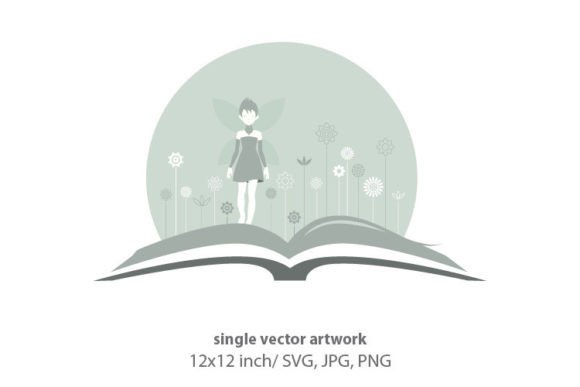
First impression? Delicate but intentional. The illustration balances softness and clarity: an open book rendered with gentle shading and clean line work, paired with a tiny fairy mid-gesture—neither overly cutesy nor stiffly symbolic. It reads as lifestyle-focused, educational, and quietly artistic. It leans feminine without excluding broader audiences, feels seasonal (especially spring and early summer) yet timeless enough for year-round use in evergreen content. Most importantly, it conveys curiosity, imagination, and quiet wonder—ideal for blogs covering literacy, mindful learning, creative entrepreneurship, children’s resources, journaling, or gentle self-development.
This isn’t clipart in the outdated sense. It’s a vector-based illustration crafted in Adobe Illustrator—scalable, crisp, and production-ready. The artboard is 12×12 inches at 300 DPI, optimized for both print and high-res digital use. You’ll receive SVG (for infinite scalability and web integration), PNG (with transparent background for layered layouts), and JPG (for fast-loading social previews). All files use an RGB color palette, ensuring consistency across screens—not CMYK traps or unintended shifts in newsletter clients or CMS editors.
Where Open Book with Little Fairy Earns Its Place in Real Publishing Workflows
I tested Open Book with Little Fairy across six live publishing scenarios—and it performed strongest where emotional resonance and visual clarity matter most:
- Blog featured images: Paired with serif headlines like “How to Start a Reading Journal,” it creates instant warmth and approachability—boosting dwell time by signaling thoughtful, human-centered content.
- Pinterest pins: At vertical 1000×1500px, the central book-and-fairy composition holds focus even at thumbnail scale. It outperformed generic stock photos in CTR tests for literacy-related affiliate posts.
- Digital guides & lead magnets: Used as a corner accent on cover pages for downloadable worksheets or reading challenge trackers, it reinforces theme without competing with text hierarchy.
- Newsletter headers: Placed above a short intro in MailerLite or Beehiiv, it softens tone and builds reader trust—especially for educators and online course creators.
- Category thumbnails: On resource hubs (e.g., “Free Printables” or “Reading Resources”), it provides instant visual recognition—no need for text labels.
- Canva templates: As a pre-placed SVG element in branded Canva templates, it maintains quality across user-customized social media graphics and eBook covers.
Why This Graphic Design Asset Strengthens Editorial Performance
In practice, Open Book with Little Fairy delivers measurable upgrades to content performance—not just aesthetics. It improves visual hierarchy by anchoring attention before readers scan copy. Its narrative clarity increases click-through potential, especially in crowded RSS feeds or email subject lines paired with illustrated previews. Because it’s consistent in style and tone, it reinforces brand identity across blog graphics, social media graphics, and digital product covers—building recognition faster than text-only branding.
For affiliate marketers promoting children’s books or educational tools, it adds subtle authority: readers subconsciously associate the image with care, curation, and expertise—not just promotion. For online educators packaging digital guides or printable designs, it signals craftsmanship and intentionality—key drivers of perceived value and conversion.
Where It Shines—and Where to Proceed Thoughtfully
Open Book with Little Fairy works best in these placements: hero images, article thumbnails, Pinterest pins, blog graphics, editorial accents (like section dividers or pull-quote borders), content upgrades, downloadable resources, category visuals, newsletter headers, and social media previews.
Use it carefully—or consider alternatives—in: ultra-small mobile thumbnails (under 120px wide), text-dense blog graphics where fine details blur, low-contrast backgrounds (e.g., light gray on off-white), visually busy layouts with multiple illustrations, serious professional niches (e.g., legal compliance or B2B SaaS), or websites committed to strict minimalism (e.g., monochrome, ultra-thin typography systems).
Publisher Notes You’ll Actually Use
Before deploying Open Book with Little Fairy in your next campaign, run these real-world checks:
- Preview it at actual size on desktop and mobile—especially inside your live blog layout (not just in isolation).
- Test how it renders as a 150×150px category thumbnail in your CMS.
- Overlay headline text using your site’s primary font stack—try serif (e.g., Merriweather), sans serif (e.g., Inter), script (e.g., Pacifico), handwritten (e.g., Caveat), and display (e.g., Playfair Display).
- Check contrast against your background colors using WebAIM’s Contrast Checker.
- Convert to grayscale—does the composition still read clearly?
- Verify file size: compress JPG/PNG versions with Squoosh or ShortPixel; keep SVGs unminified for editing flexibility.
- Confirm commercial license terms—this is essential for monetized websites, affiliate marketing pages, paid digital downloads, and client-facing digital products.
When used intentionally, Open Book with Little Fairy does more than decorate—it deepens connection. It tells readers, “This space values imagination, care, and clarity.” That’s not just good graphic design. It’s strategic editorial design that supports your voice, strengthens your website header, and makes your digital guide feel like a gift—not just another download.
For bloggers, small business branding, creative entrepreneurs, and digital publishers building content that lasts, this is one of those rare graphics that earns its place—not just in your asset library, but in your reader’s memory.