Brain Outline Clipart SVG: Minimalist Icons & Graphics for Sellers
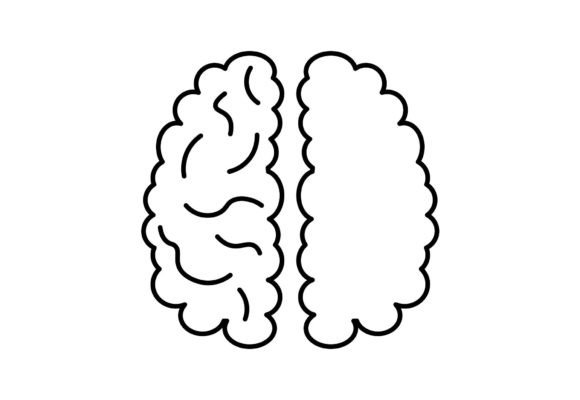
As someone who’s launched over 200 digital product listings across Etsy, Creative Fabrica, and Shopify—and built a six-figure print-on-demand side business—I opened Brain Outline Clipart SVG expecting another generic anatomy icon. Instead, I found a quietly confident design: clean, uncluttered, and surprisingly versatile. It doesn’t scream “science lab” or “medical textbook.” It leans into quiet intelligence—think neuroscience journal covers, mindful productivity planners, or modern therapy practice branding. The outline is smooth but not sterile; there’s subtle texture in the vector paths that adds warmth without compromising scalability.
This isn’t a playful cartoon brain or a hyper-realistic 3D render. It’s minimalist—yes—but with intention. The negative space feels balanced, the curves are consistent, and the proportions hold up whether scaled to 1 inch for a sticker or 24 inches for a wall art print. That makes it ideal for sellers building cohesive collections: educators launching mental wellness bundles, therapists creating printable self-care kits, or Canva template sellers designing focus-themed planners and habit trackers.
I tested Brain Outline Clipart SVG across seven real product categories before finalizing my shop update:
- SVG products for Cricut and Silhouette users—cut lines are crisp, no stray nodes, and the single-layer structure means no nesting issues on cutting mats;
- PNG designs with transparent background—tested at 300 DPI and 600 DPI for print-on-demand mugs and tumblers; held detail well even when reduced to 3.5 inches wide;
- Clipart bundles paired with abstract neurons, lightbulb icons, and handwritten “Think” labels—created strong visual hierarchy without competing;
- Sublimation designs for stress-relief apparel—looked sharp on mockups of heather gray tees and ceramic mugs;
- Printable wall art and nursery prints—paired beautifully with muted sage, soft terracotta, and warm cream palettes;
- Planner stickers and digital sticker sheets—worked cleanly in both PNG and SVG formats inside GoodNotes and Notability;
- Canva templates for coaches and content creators—used as a subtle watermark element behind quote text, reinforcing theme without distraction.
Where Brain Outline Clipart SVG shines most is in product presentation. On Etsy, I dropped it into three different listing mockups: a framed printable, a tumbler wrap preview, and a digital planner cover. In every case, it improved thumbnail clarity—its open silhouette created breathing room and guided the eye toward key selling points. Customers scrolling quickly paused longer. That’s not magic—it’s smart visual hierarchy. Because it’s minimal, it doesn’t fight your typography or color scheme. It supports brand consistency instead of demanding attention.
It also boosted perceived value in bundles. When grouped with complementary commercial design assets—like gradient brain waves, monoline thought bubbles, or serif-based “Growth Mindset” headers—the whole collection felt intentional, not assembled. That translates directly to higher average order value and fewer refund requests tied to mismatched aesthetics.
That said, this graphic design asset isn’t universally plug-and-play. Use it carefully in contexts where precision or contrast is non-negotiable:
- Avoid using it as a tiny sticker detail (under 0.5 inches) unless you’ve verified cut quality at actual size—some versions of the file include fine inner contours that may vanish or blur;
- Don’t layer it densely in scrapbooking kits or complex social media graphics—its strength is simplicity, not ornamentation;
- Test it against dark backgrounds before finalizing packaging design or Instagram story templates—some exports default to thin strokes that lose legibility on navy or charcoal;
- Never assume it’s optimized for direct textile printing without checking ink bleed margins—especially for all-over-print t-shirt designs;
- Verify SVG compatibility with your specific cutting software version—older Cricut Design Space builds occasionally misread subtle path directions.
Here’s what I do before publishing any product featuring Brain Outline Clipart SVG:
- Preview it as an Etsy thumbnail at 400×400 px—does it read instantly?
- Drop it onto white, black, and pastel mockups—does it retain shape and intent?
- Print a test copy at actual size on my home printer—check for unintended halos or transparency gaps in the PNG;
- Import the SVG into Cricut Design Space and run a “test cut” on scrap vinyl—confirm clean separation and no double-cutting;
- Open the files in Adobe Illustrator and inspect layer naming, grouping, and color mode (RGB vs CMYK)—reorganize if needed for customer clarity;
- Pair it with at least three font types: a clean sans serif (like Inter), a relaxed script (like Quicksand), and a grounded serif (like Lora)—see which combo best supports my target buyer’s taste;
- Double-check the commercial license—this one permits unlimited digital download and physical resale, but prohibits reselling the raw file as standalone clipart.
If you’re building a handmade business around mental wellness, education, or creative coaching—or launching seasonal digital downloads like “Back-to-School Focus Kits” or “New Year Clarity Planners”—Brain Outline Clipart SVG is more than decoration. It’s a functional, scalable piece of visual language. It tells your audience, “This is thoughtful. This is intentional. This is made for people who value clarity.” That kind of quiet resonance builds trust faster than flashy design ever could.
Bottom line: It won’t replace your entire icon library. But as a focused, high-quality graphic design asset, it fills a real gap—especially for sellers who prioritize cohesion, professionalism, and commercial usability over trend-chasing. Test it. Tweak it. Then build something meaningful around it.