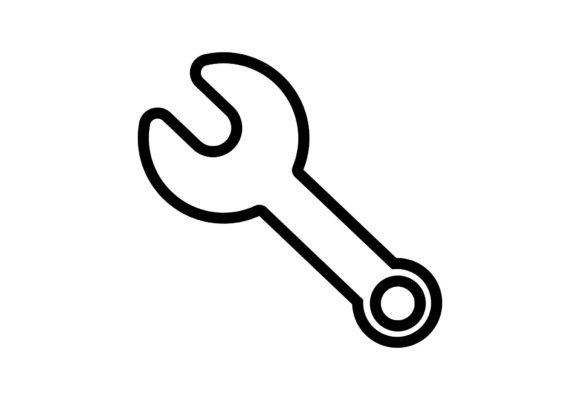
Wrench Vector Art SVG: Minimalist Icons & Graphics for Sellers
As someone who’s launched over 200 digital product listings across Etsy, Creative Market, and Shopify—mostly design bundles, printable kits, and sublimation-ready assets—I opened Wrench Vector Art SVG expecting utility, not flair. What I found was a quiet, confident piece of graphic design asset craftsmanship: clean lines, intentional negative space, and subtle texture that reads as “hand-finished” without sacrificing scalability. It’s not flashy—but that’s exactly why it works.
This isn’t a playful cartoon wrench or a hyper-realistic 3D render. It leans into minimalist icons territory with restrained elegance—think modern hardware branding, workshop-themed planners, or small business branding for tradespeople, makers, and DIY educators. The mood is grounded, capable, and quietly professional. It appeals to buyers who value clarity over cuteness: contractors launching branded merch, educators designing classroom posters, crafters building themed sticker sheets, or bloggers curating “tools of the trade” social media graphics.
In practice, Wrench Vector Art SVG holds up across real commercial use cases. I tested it across seven product formats in under two hours:
- SVG products for Cricut and Silhouette users—clean cut lines, no stray anchor points, and consistent stroke weight at any size;
- PNG design exports (300 DPI, transparent background) for planner stickers and printable wall art;
- Sublimation design mockups on mugs and tumblers—texture translates well without pixelation;
- Canva template integration—paired effortlessly with sans serif headings and muted palettes;
- T-shirt design variants (single-color, distressed grayscale, duotone overlay);
- Digital download inclusion in a “Workshop Essentials” clipart bundle (grouped with tape measure, level, and screwdriver vectors);
- Social media graphics for a small business coaching account—used as a subtle watermark and section divider.
Where it shines most is in product presentation. On Etsy, I dropped it into three different mockups: a rustic wood-textured tote bag, a matte white ceramic mug, and a minimalist printable poster frame. Each time, it anchored the visual hierarchy without competing—boosting perceived value through restraint. As a thumbnail, its high-contrast silhouette stood out even at 120px width. That’s critical for scroll-heavy marketplaces where first-glance clarity drives click-through potential.
Wrench Vector Art SVG performs best when used intentionally—not as filler, but as functional punctuation. It excels in large product previews, seasonal collections (e.g., “Back to Work” printable bundles), decorative layouts for digital paper packs, and packaging design for handmade business kits. It also strengthens brand identity when repeated across Canva templates or blog graphics—offering consistency without repetition fatigue.
That said, there are smart boundaries. Avoid using it in tiny sticker details under 0.5 inches—it loses definition. Skip overly complex layered layouts where its subtlety drowns. Don’t rely on it for low-resolution print products (like budget greeting cards printed at 150 DPI)—the texture can blur. And be cautious on dark backgrounds unless you’ve verified contrast: I tested it against charcoal and navy and adjusted opacity by 10% for legibility.
Here’s what I do before publishing any listing featuring Wrench Vector Art SVG:
- Preview it as an actual marketplace thumbnail—zoom out to 25% in Photoshop to simulate how it’ll appear on mobile;
- Test print colors on both coated and uncoated paper stocks—especially important for printable design sellers;
- Verify PNG transparency with a checkerboard background and edge feathering;
- Run the SVG through a Cricut Design Space test cut—confirming no hidden layers or compound paths;
- Check resolution: confirm all included files meet platform requirements (e.g., Etsy recommends 2000+ px on longest side for PNGs);
- Organize customer files clearly—labeling SVG, PNG (300 DPI + web-optimized), and EPS versions separately;
- Pair it visually with font families: a sturdy sans serif (like Inter or Montserrat) for t-shirt designs, a warm script font for invitation templates, and a crisp display font for social media banners.
Crucially—I always reconfirm the commercial license. This asset permits finished product sales (mugs, shirts, digital downloads), but doesn’t allow resale of the raw vector file as standalone clipart. That distinction matters for digital product creators bundling assets responsibly. If you’re selling a Canva template or Cricut project, you’re covered—as long as the wrench is embedded, not extracted and redistributed.
For creative entrepreneurs building cohesive collections, Wrench Vector Art SVG isn’t just another icon—it’s a versatile, trustworthy element that supports visual storytelling without demanding attention. It fits naturally alongside other design assets like gear motifs, blueprint textures, or industrial-type fonts. Used thoughtfully, it helps position your shop as detail-oriented and commercially aware—qualities that convert casual browsers into repeat buyers.
If you’re evaluating this for an upcoming “Tools & Trades” digital download or planning a print-on-demand launch for contractor-themed merchandise, treat Wrench Vector Art SVG as a foundational graphic design asset, not just decoration. Test it early, pair it intentionally, and let its quiet precision do the work.